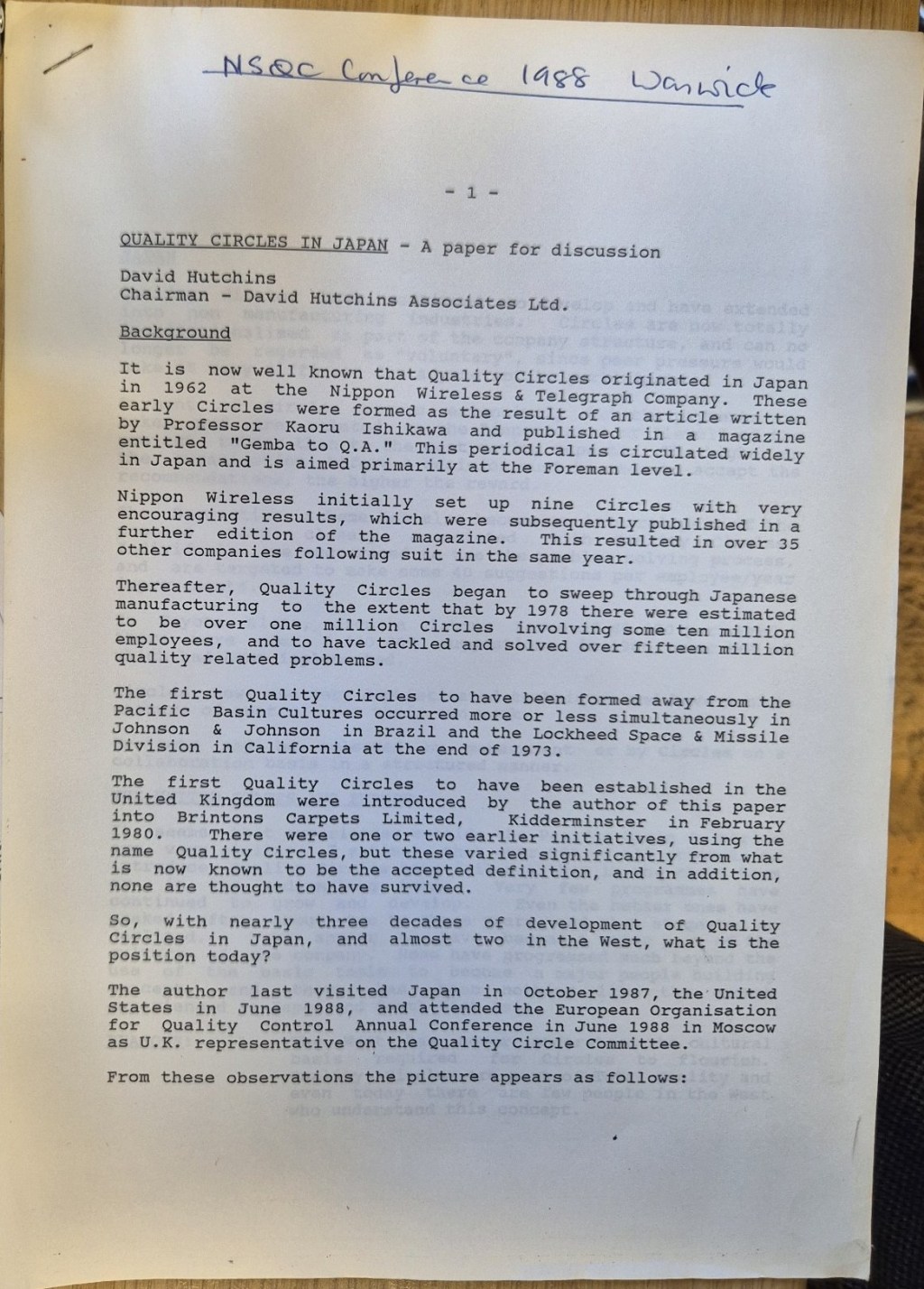
Presented by David Hutchins at the NSQC Conference, Warwick, 1988.
Why it still matters
I found this paper in my archive during World Quality Month 2026. I wrote it after visiting Japan in 1987 and the United States in 1988. In 1986 Toyota alone received over 2.6 million suggestions from 60,000 people, and put over 96% of them into practice. In the West, I estimated that over 90% of attempts to introduce Quality Circles had failed. Nearly 40 years on, read my reasons and judge for yourself how much has changed.
Background
It is now well known that Quality Circles originated in Japan in 1962 at the Nippon Wireless & Telegraph Company. These early Circles were formed as the result of an article written by Professor Kaoru Ishikawa and published in a magazine entitled “Gemba to Q.A.” This periodical is circulated widely in Japan and is aimed primarily at the Foreman level.
Nippon Wireless initially set up nine Circles with very encouraging results, which were subsequently published in a further edition of the magazine. This resulted in over 35 other companies following suit in the same year.
Thereafter, Quality Circles began to sweep through Japanese manufacturing to the extent that by 1978 there were estimated to be over one million Circles involving some ten million employees, and to have tackled and solved over fifteen million quality related problems.
The first Quality Circles to have been formed away from the Pacific Basin Cultures occurred more or less simultaneously in Johnson & Johnson in Brazil and the Lockheed Space & Missile Division in California at the end of 1973.
The first Quality Circles to have been established in the United Kingdom were introduced by the author of this paper into Brintons Carpets Limited, Kidderminster in February 1980. There were one or two earlier initiatives, using the name Quality Circles, but these varied significantly from what is now known to be the accepted definition, and in addition, none are thought to have survived.
So, with nearly three decades of development of Quality Circles in Japan, and almost two in the West, what is the position today?
The author last visited Japan in October 1987, the United States in June 1988, and attended the European Organisation for Quality Control Annual Conference in June 1988 in Moscow as U.K. representative on the Quality Circle Committee.
From these observations the picture appears as follows:
Japan
Quality Circles have continued to develop and have extended into non manufacturing industries. Circles are now totally institutionalised as part of the company structure, and can no longer be regarded as “voluntary”, since peer pressure would make it very difficult for anyone not to participate.
Payment of Circles occurs extensively but the payments are token and are related to the “importance” or “level” of the project rather than to the cost saving aspects. The higher in the organisation before a decision must be made to accept the recommendations, the higher the reward.
The Suggestion Scheme has also become an integral part of the process very closely associated with Quality Circles. Individuals are encouraged to use the problem solving process, and are targeted to make some 40 suggestions per employee/year improvements.
In Toyota alone, from a labour force of 60,000 personnel, there were over 2,600,000 suggestions in 1986, over 96% of which had been implemented.
Circles now use very sophisticated techniques and have a high measure of control over their own work.
Projects may be selected by management or by Circles on a collaboration basis in a structured manner.
The United States and Europe
It seems that experiences outside the Pacific Basin Countries are very similar. I estimate that over 90% of all attempts to introduce Quality Circles have failed either in the short term or in the medium/long term. Very few programmes have continued to grow and develop. Even the better ones have peaked after about two to three years, and then stagnated or declined. None appear to have become a major part of the culture of the company. None have progressed much beyond the use of the basic tools to become a major people building concept, and there has been nothing like the growth experienced in Japan and South East Asia.
Reasons:
- The West has never understood the cultural basis required for Circles to flourish. Quality Circles are part of Total Quality and even today there are few people in the West who understand this concept.
- The West is always looking for panaceas or gurus to follow. Eg Deming, Taguchi.
- Western Management is transient and therefore looking for short term solutions – the Quick Fix.
- The West will not let go of Taylorism, and until it does, it can never achieve the full benefits of Quality Circles, Total Quality or Just in Time.
- There have been few attempts to introduce the concepts into Society, and where they have, rivalry and incompetence has generally led to unclear understanding.
The Japanese have the advantage that they are more concerned with the common good than personal aggrandisement. This is probably the single biggest cause of failure in the U.K.
The Future
Japan is continuing to innovate, consolidate and progress. The West still argues as to which path to follow. We did not have time on our side when we first began to debate these concepts. There is even less now, and it may not even be possible to re-establish our competitive position.
Perhaps our culture is against it, but we have a decision to make.
- Do we want a high standard of living for ourselves and our children?
- Do we want our children to be proud of the legacy we will leave them?
- Do we want to work for Japanese or other non-British companies? Paradoxically it is those who resist the development of competitive strategies who will suffer the most.
- Their companies will eventually be overwhelmed by foreign competition.
- Their new employers will be operating in this manner anyway.
© David Hutchins 1988. May be quoted with acknowledgement.

