

Experience • Leadership • Empowerment

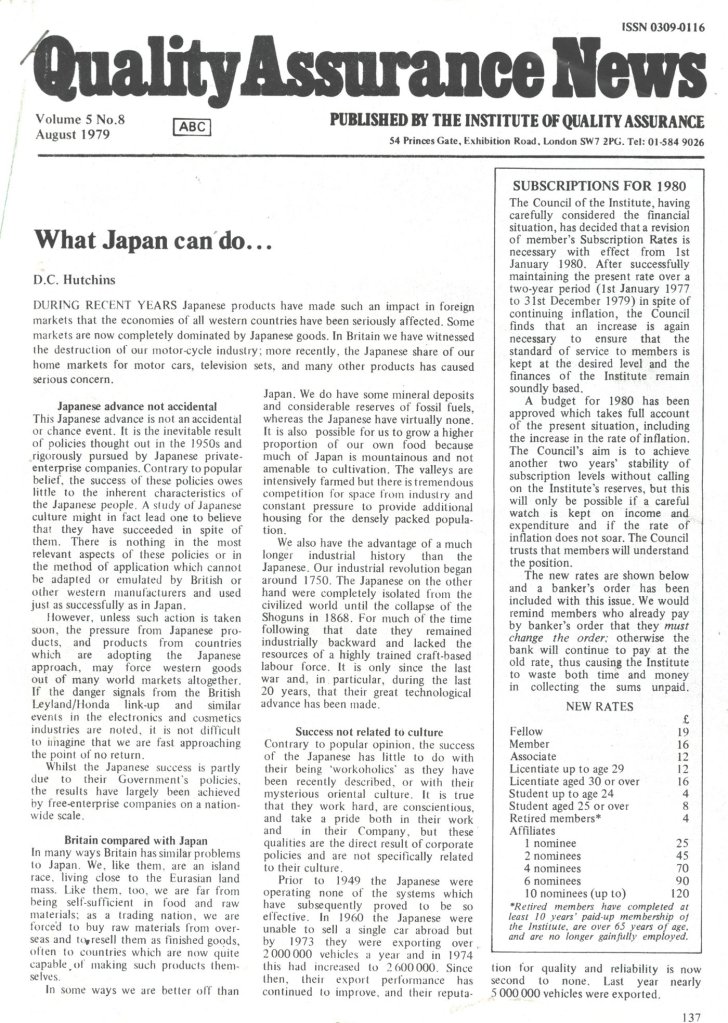
D.C. Hutchins
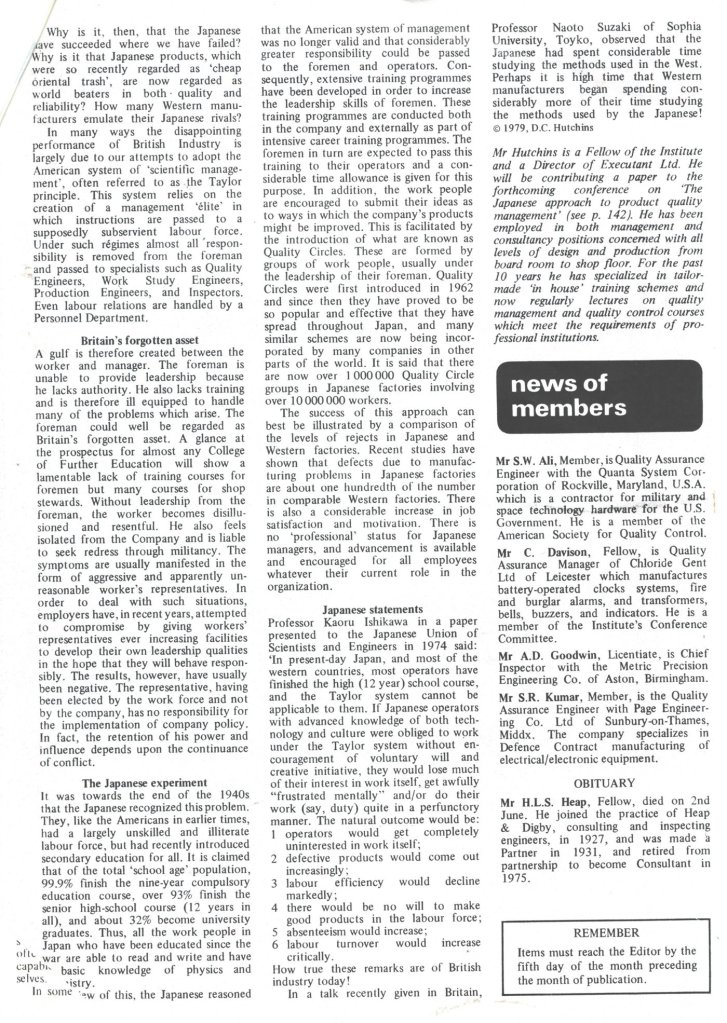
First published as the front-page article in Quality Assurance News, the journal of the Institute of Quality Assurance, Volume 5 No. 8, August 1979, pages 137–138. Reproduced in full; the figures and language are those of 1979.
DURING RECENT YEARS Japanese products have made such an impact in foreign markets that the economies of all western countries have been seriously affected. Some markets are now completely dominated by Japanese goods. In Britain we have witnessed the destruction of our motor-cycle industry; more recently, the Japanese share of our home markets for motor cars, television sets, and many other products has caused serious concern.
Japanese advance not accidental
This Japanese advance is not an accidental or chance event. It is the inevitable result of policies thought out in the 1950s and rigorously pursued by Japanese private-enterprise companies. Contrary to popular belief, the success of these policies owes little to the inherent characteristics of the Japanese people. A study of Japanese culture might in fact lead one to believe that they have succeeded in spite of them. There is nothing in the most relevant aspects of these policies or in the method of application which cannot be adapted or emulated by British or other western manufacturers and used just as successfully as in Japan.
However, unless such action is taken soon, the pressure from Japanese products, and products from countries which are adopting the Japanese approach, may force western goods out of many world markets altogether. If the danger signals from the British Leyland/Honda link-up and similar events in the electronics and cosmetics industries are noted, it is not difficult to imagine that we are fast approaching the point of no return.
Whilst the Japanese success is partly due to their Government’s policies, the results have largely been achieved by free-enterprise companies on a nation-wide scale.
Britain compared with Japan
In many ways Britain has similar problems to Japan. We, like them, are an island race, living close to the Eurasian land mass. Like them, too, we are far from being self-sufficient in food and raw materials; as a trading nation, we are forced to buy raw materials from overseas and to resell them as finished goods, often to countries which are now quite capable of making such products themselves.
In some ways we are better off than Japan. We do have some mineral deposits and considerable reserves of fossil fuels, whereas the Japanese have virtually none. It is also possible for us to grow a higher proportion of our own food because much of Japan is mountainous and not amenable to cultivation. The valleys are intensively farmed but there is tremendous competition for space from industry and constant pressure to provide additional housing for the densely packed population.
We also have the advantage of a much longer industrial history than the Japanese. Our industrial revolution began around 1750. The Japanese on the other hand were completely isolated from the civilized world until the collapse of the Shoguns in 1868. For much of the time following that date they remained industrially backward and lacked the resources of a highly trained craft-based labour force. It is only since the last war and, in particular, during the last 20 years, that their great technological advance has been made.
Success not related to culture
Contrary to popular opinion, the success of the Japanese has little to do with their being ‘workaholics’ as they have been recently described, or with their mysterious oriental culture. It is true that they work hard, are conscientious, and take a pride both in their work and in their Company, but these qualities are the direct result of corporate policies and are not specifically related to their culture.
Prior to 1949 the Japanese were operating none of the systems which have subsequently proved to be so effective. In 1960 the Japanese were unable to sell a single car abroad but by 1973 they were exporting over 2,000,000 vehicles a year and in 1974 this had increased to 2,600,000. Since then, their export performance has continued to improve, and their reputation for quality and reliability is now second to none. Last year nearly 5,000,000 vehicles were exported.
Why is it, then, that the Japanese have succeeded where we have failed? Why is it that Japanese products, which were so recently regarded as ‘cheap oriental trash’, are now regarded as world beaters in both quality and reliability? How many Western manufacturers emulate their Japanese rivals?
In many ways the disappointing performance of British Industry is largely due to our attempts to adopt the American system of ‘scientific management’, often referred to as the Taylor principle. This system relies on the creation of a management ‘élite’ in which instructions are passed to a supposedly subservient labour force. Under such régimes almost all responsibility is removed from the foreman and passed to specialists such as Quality Engineers, Work Study Engineers, Production Engineers, and Inspectors. Even labour relations are handled by a Personnel Department.
Britain’s forgotten asset
A gulf is therefore created between the worker and manager. The foreman is unable to provide leadership because he lacks authority. He also lacks training and is therefore ill equipped to handle many of the problems which arise. The foreman could well be regarded as Britain’s forgotten asset. A glance at the prospectus for almost any College of Further Education will show a lamentable lack of training courses for foremen but many courses for shop stewards. Without leadership from the foreman, the worker becomes disillusioned and resentful. He also feels isolated from the Company and is liable to seek redress through militancy. The symptoms are usually manifested in the form of aggressive and apparently unreasonable worker’s representatives. In order to deal with such situations, employers have, in recent years, attempted to compromise by giving workers’ representatives ever increasing facilities to develop their own leadership qualities in the hope that they will behave responsibly. The results, however, have usually been negative. The representative, having been elected by the work force and not by the company, has no responsibility for the implementation of company policy. In fact, the retention of his power and influence depends upon the continuance of conflict.
The Japanese experiment
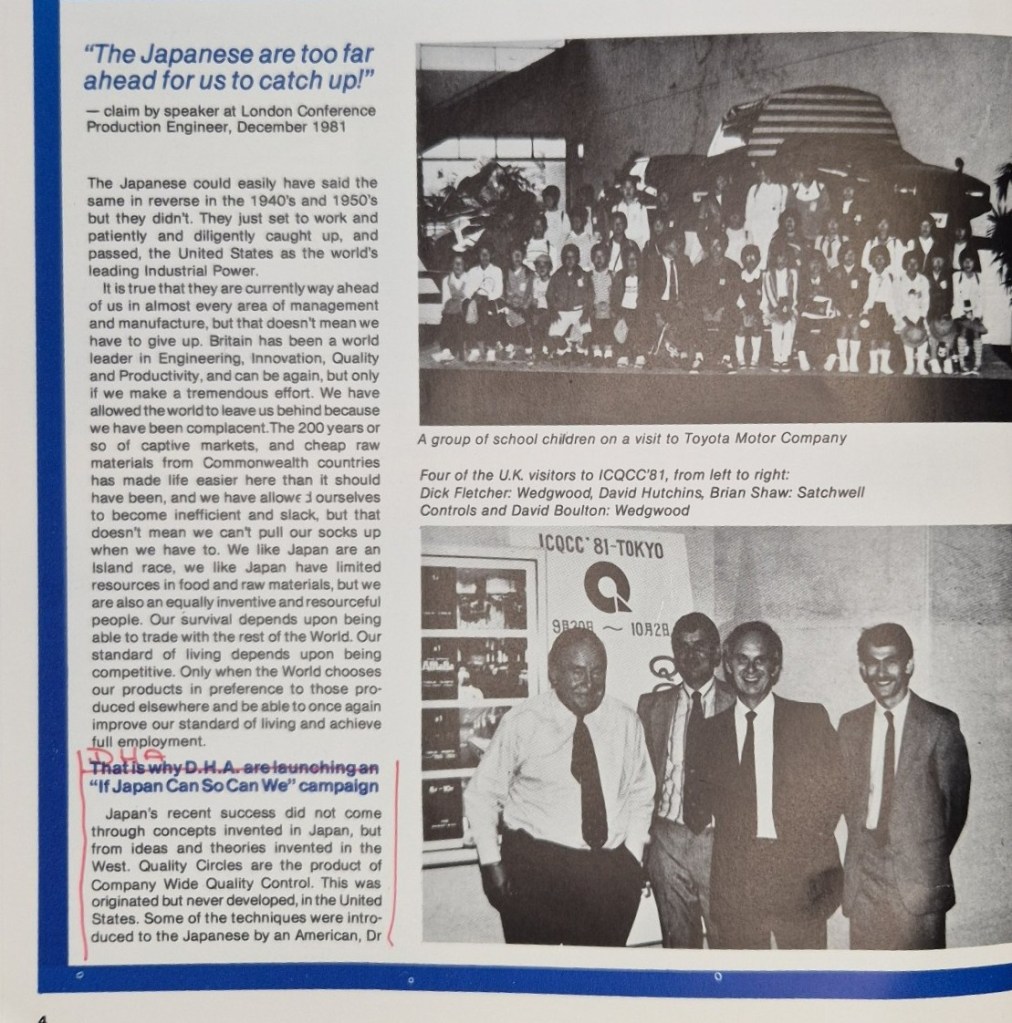
It was towards the end of the 1940s that the Japanese recognized this problem. They, like the Americans in earlier times, had a largely unskilled and illiterate labour force, but had recently introduced secondary education for all. It is claimed that of the total ‘school age’ population, 99.9% finish the nine-year compulsory education course, over 93% finish the senior high-school course (12 years in all), and about 32% become university graduates. Thus, all the work people in Japan who have been educated since the war are able to read and write and have basic knowledge of physics and chemistry.
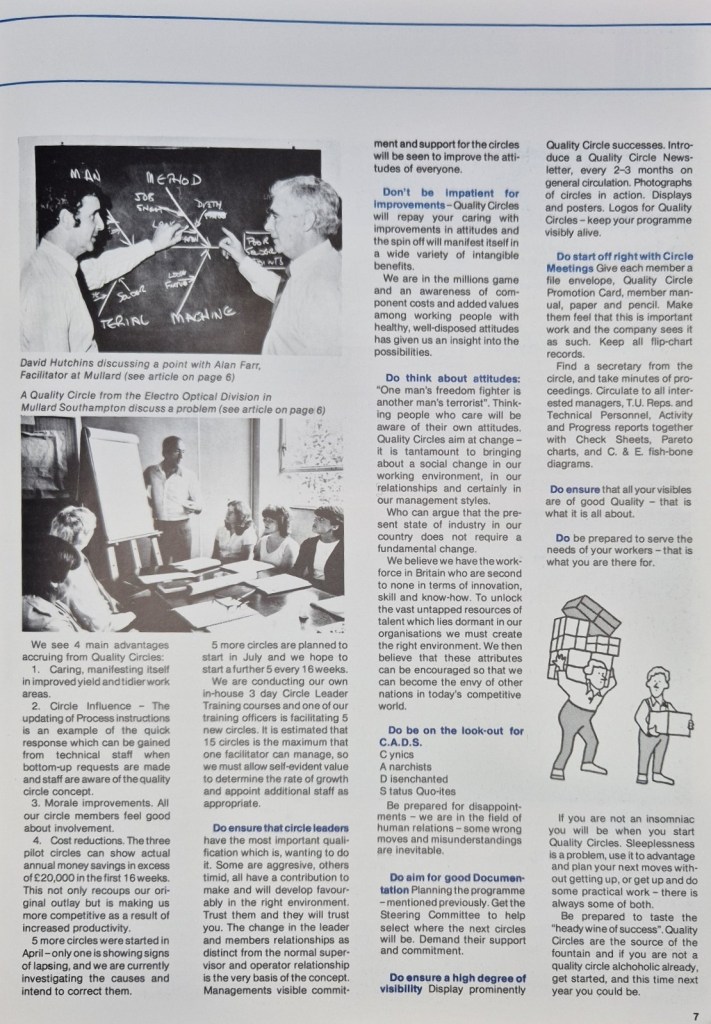
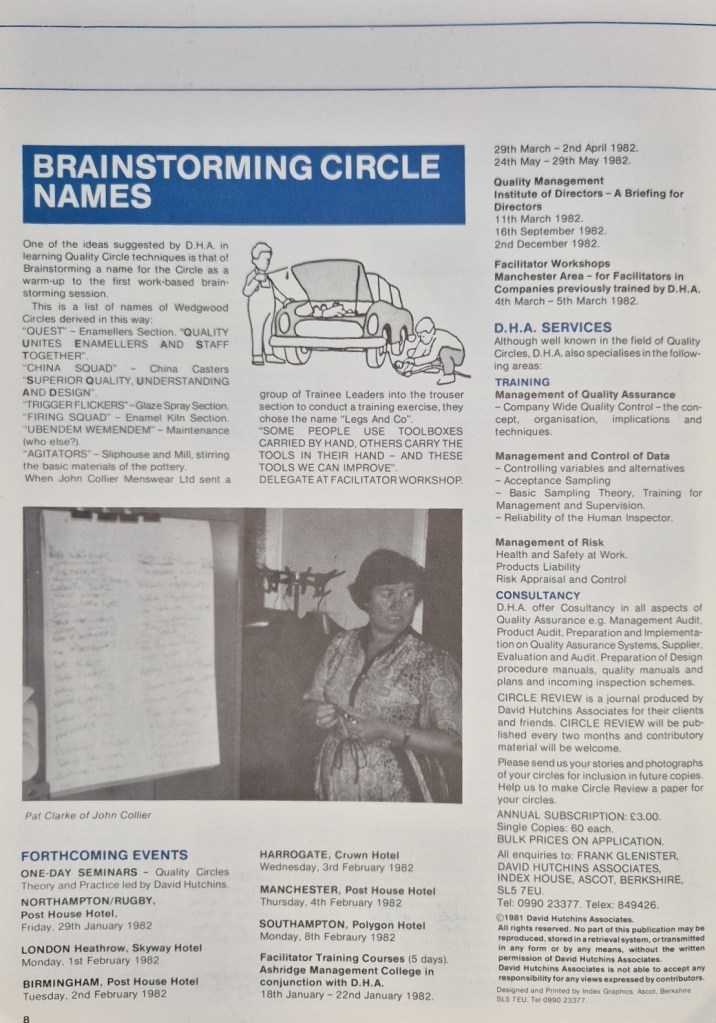
In view of this, the Japanese reasoned that the American system of management was no longer valid and that considerably greater responsibility could be passed to the foremen and operators. Consequently, extensive training programmes have been developed in order to increase the leadership skills of foremen. These training programmes are conducted both in the company and externally as part of intensive career training programmes. The foremen in turn are expected to pass this training to their operators and a considerable time allowance is given for this purpose. In addition, the work people are encouraged to submit their ideas as to ways in which the company’s products might be improved. This is facilitated by the introduction of what are known as Quality Circles. These are formed by groups of work people, usually under the leadership of their foreman. Quality Circles were first introduced in 1962 and since then they have proved to be so popular and effective that they have spread throughout Japan, and many similar schemes are now being incorporated by many companies in other parts of the world. It is said that there are now over 1,000,000 Quality Circle groups in Japanese factories involving over 10,000,000 workers.
The success of this approach can best be illustrated by a comparison of the levels of rejects in Japanese and Western factories. Recent studies have shown that defects due to manufacturing problems in Japanese factories are about one hundredth of the number in comparable Western factories. There is also a considerable increase in job satisfaction and motivation. There is no ‘professional’ status for Japanese managers, and advancement is available and encouraged for all employees whatever their current role in the organization.
Japanese statements
Professor Kaoru Ishikawa in a paper presented to the Japanese Union of Scientists and Engineers in 1974 said: ‘In present-day Japan, and most of the western countries, most operators have finished the high (12 year) school course, and the Taylor system cannot be applicable to them. If Japanese operators with advanced knowledge of both technology and culture were obliged to work under the Taylor system without encouragement of voluntary will and creative initiative, they would lose much of their interest in work itself, get awfully “frustrated mentally” and/or do their work (say, duty) quite in a perfunctory manner. The natural outcome would be:
1. operators would get completely uninterested in work itself;
2. defective products would come out increasingly;
3. labour efficiency would decline markedly;
4. there would be no will to make good products in the labour force;
5. absenteeism would increase;
6. labour turnover would increase critically.’
How true these remarks are of British industry today!
In a talk recently given in Britain, Professor Naoto Sasaki of Sophia University, Tokyo, observed that the Japanese had spent considerable time studying the methods used in the West. Perhaps it is high time that Western manufacturers began spending considerably more of their time studying the methods used by the Japanese!
© 1979, D.C. Hutchins
← Back to the Library
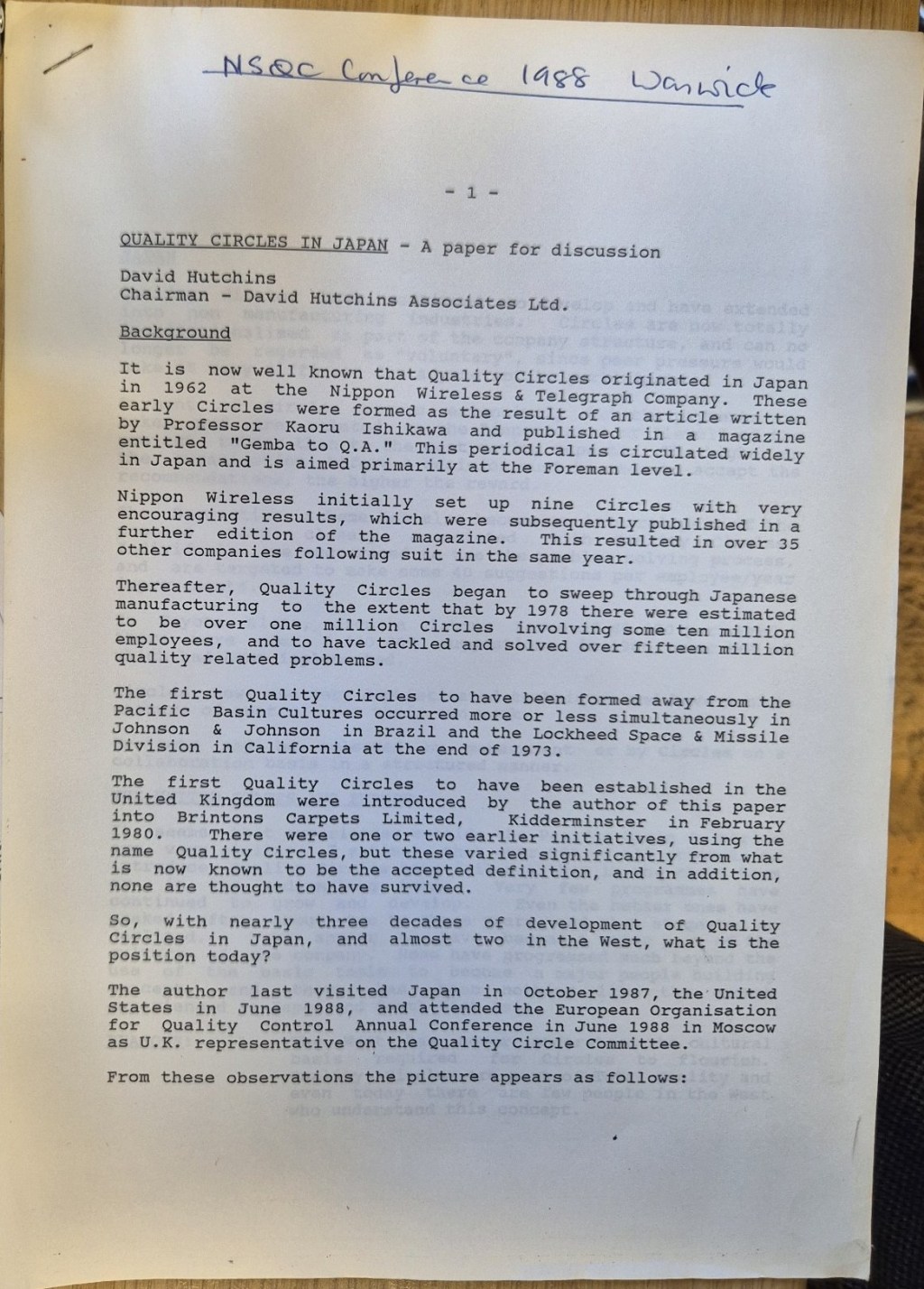
Presented by David Hutchins at the NSQC Conference, Warwick, 1988.
Why it still matters
I found this paper in my archive during World Quality Month 2026. I wrote it after visiting Japan in 1987 and the United States in 1988. In 1986 Toyota alone received over 2.6 million suggestions from 60,000 people, and put over 96% of them into practice. In the West, I estimated that over 90% of attempts to introduce Quality Circles had failed. Nearly 40 years on, read my reasons and judge for yourself how much has changed.
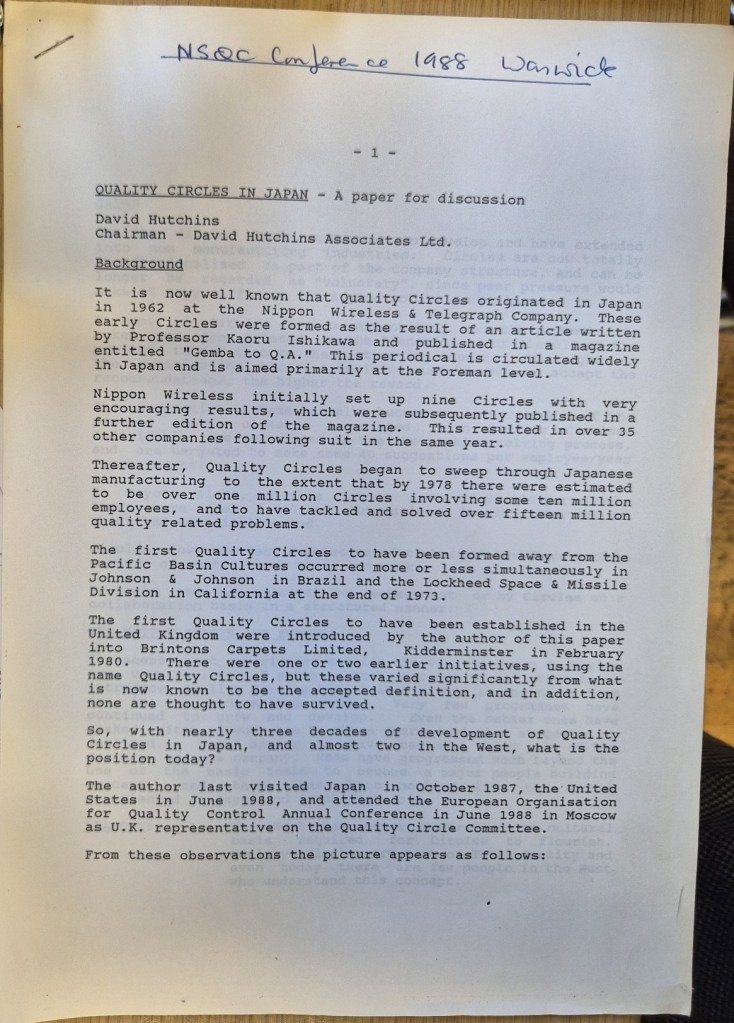
It is now well known that Quality Circles originated in Japan in 1962 at the Nippon Wireless & Telegraph Company. These early Circles were formed as the result of an article written by Professor Kaoru Ishikawa and published in a magazine entitled “Gemba to Q.A.” This periodical is circulated widely in Japan and is aimed primarily at the Foreman level.
Nippon Wireless initially set up nine Circles with very encouraging results, which were subsequently published in a further edition of the magazine. This resulted in over 35 other companies following suit in the same year.
Thereafter, Quality Circles began to sweep through Japanese manufacturing to the extent that by 1978 there were estimated to be over one million Circles involving some ten million employees, and to have tackled and solved over fifteen million quality related problems.
The first Quality Circles to have been formed away from the Pacific Basin Cultures occurred more or less simultaneously in Johnson & Johnson in Brazil and the Lockheed Space & Missile Division in California at the end of 1973.
The first Quality Circles to have been established in the United Kingdom were introduced by the author of this paper into Brintons Carpets Limited, Kidderminster in February 1980. There were one or two earlier initiatives, using the name Quality Circles, but these varied significantly from what is now known to be the accepted definition, and in addition, none are thought to have survived.
So, with nearly three decades of development of Quality Circles in Japan, and almost two in the West, what is the position today?
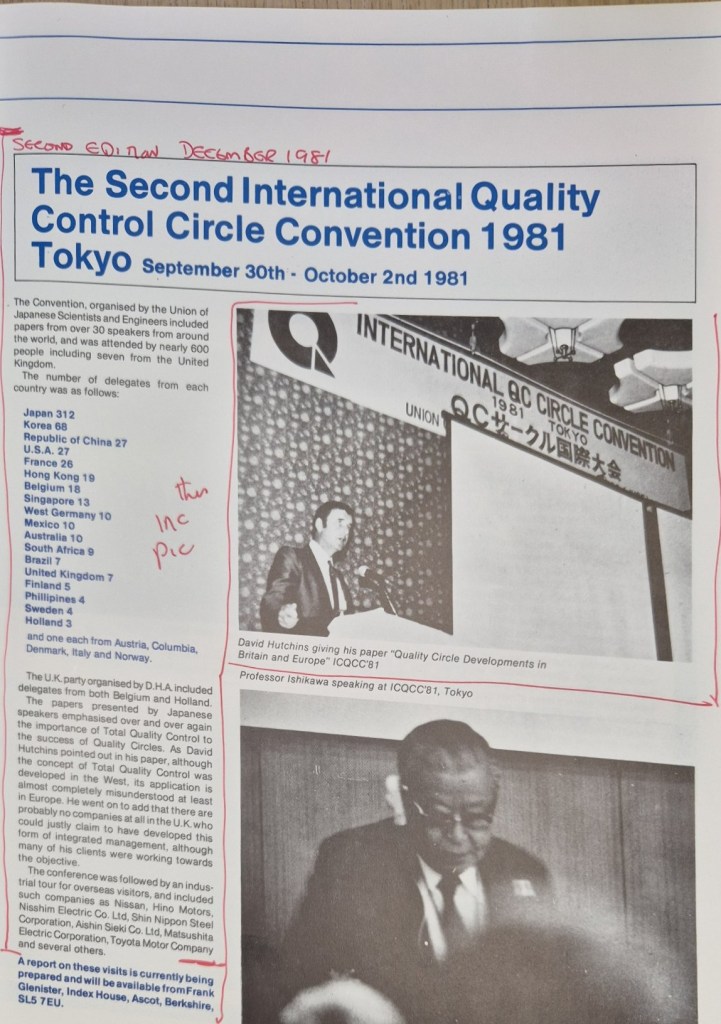
The author last visited Japan in October 1987, the United States in June 1988, and attended the European Organisation for Quality Control Annual Conference in June 1988 in Moscow as U.K. representative on the Quality Circle Committee.
From these observations the picture appears as follows:
Quality Circles have continued to develop and have extended into non manufacturing industries. Circles are now totally institutionalised as part of the company structure, and can no longer be regarded as “voluntary”, since peer pressure would make it very difficult for anyone not to participate.
Payment of Circles occurs extensively but the payments are token and are related to the “importance” or “level” of the project rather than to the cost saving aspects. The higher in the organisation before a decision must be made to accept the recommendations, the higher the reward.
The Suggestion Scheme has also become an integral part of the process very closely associated with Quality Circles. Individuals are encouraged to use the problem solving process, and are targeted to make some 40 suggestions per employee/year improvements.
In Toyota alone, from a labour force of 60,000 personnel, there were over 2,600,000 suggestions in 1986, over 96% of which had been implemented.
Circles now use very sophisticated techniques and have a high measure of control over their own work.
Projects may be selected by management or by Circles on a collaboration basis in a structured manner.
It seems that experiences outside the Pacific Basin Countries are very similar. I estimate that over 90% of all attempts to introduce Quality Circles have failed either in the short term or in the medium/long term. Very few programmes have continued to grow and develop. Even the better ones have peaked after about two to three years, and then stagnated or declined. None appear to have become a major part of the culture of the company. None have progressed much beyond the use of the basic tools to become a major people building concept, and there has been nothing like the growth experienced in Japan and South East Asia.
Reasons:
The Japanese have the advantage that they are more concerned with the common good than personal aggrandisement. This is probably the single biggest cause of failure in the U.K.
Japan is continuing to innovate, consolidate and progress. The West still argues as to which path to follow. We did not have time on our side when we first began to debate these concepts. There is even less now, and it may not even be possible to re-establish our competitive position.
Perhaps our culture is against it, but we have a decision to make.
© David Hutchins 1988. May be quoted with acknowledgement.