Author: David Hutchins

  • Quality Circles in Japan: a paper for discussion (1988)

    Quality Circles in Japan: a paper for discussion (1988)

    Presented by David Hutchins at the NSQC Conference, Warwick, 1988.

    Why it still matters

    I found this paper in my archive during World Quality Month 2026. I wrote it after visiting Japan in 1987 and the United States in 1988. In 1986 Toyota alone received over 2.6 million suggestions from 60,000 people, and put over 96% of them into practice. In the West, I estimated that over 90% of attempts to introduce Quality Circles had failed. Nearly 40 years on, read my reasons and judge for yourself how much has changed.
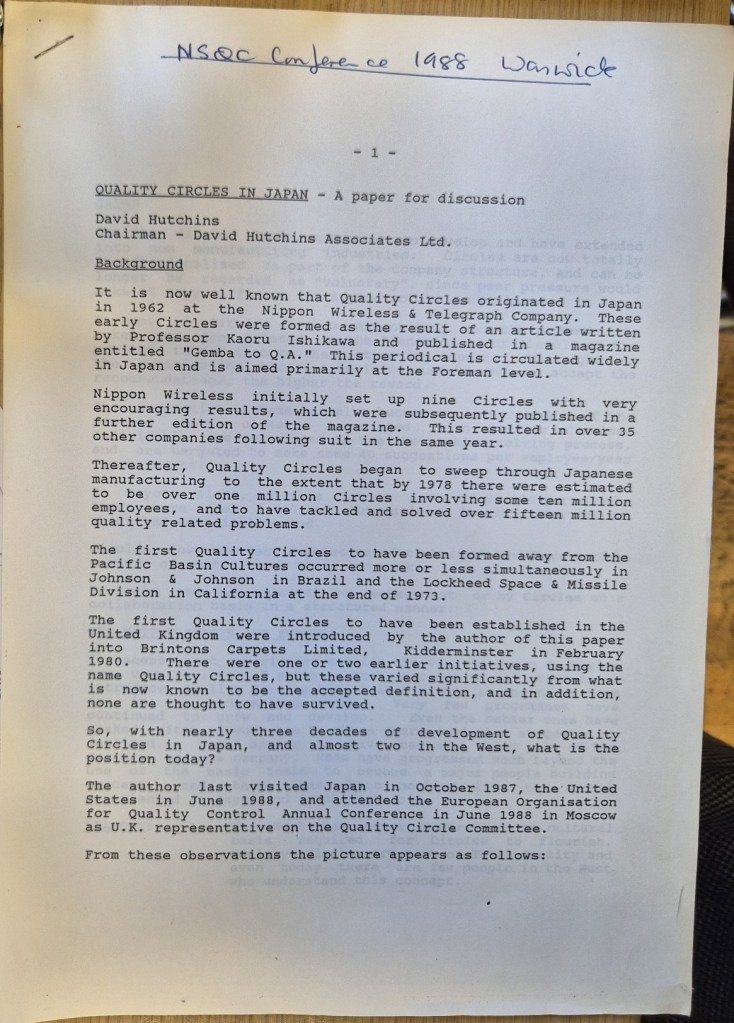
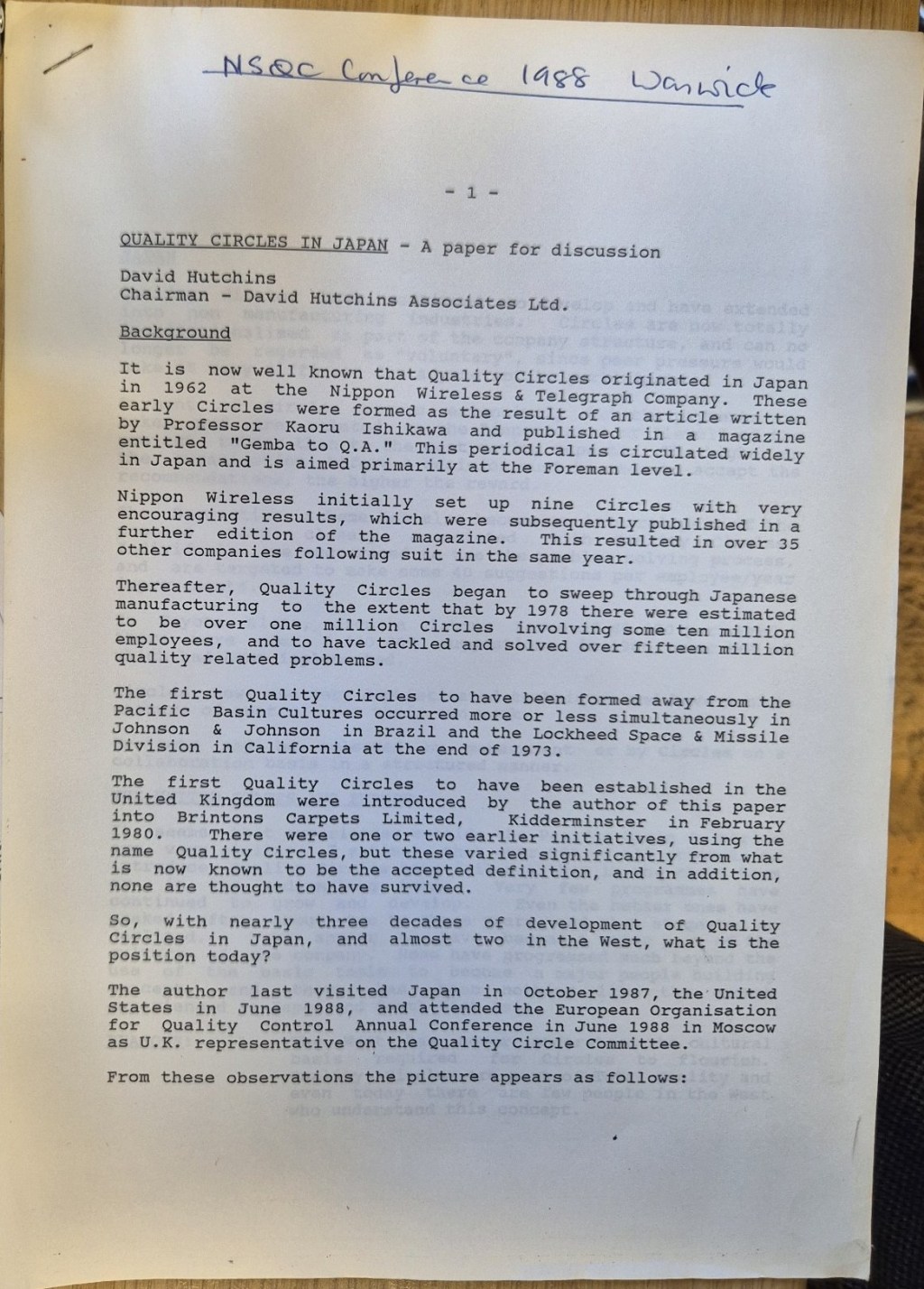
    Page 1 of David Hutchins’ 1988 NSQC Conference paper, Quality Circles in Japan

    Background

    It is now well known that Quality Circles originated in Japan in 1962 at the Nippon Wireless & Telegraph Company. These early Circles were formed as the result of an article written by Professor Kaoru Ishikawa and published in a magazine entitled “Gemba to Q.A.” This periodical is circulated widely in Japan and is aimed primarily at the Foreman level.

    Nippon Wireless initially set up nine Circles with very encouraging results, which were subsequently published in a further edition of the magazine. This resulted in over 35 other companies following suit in the same year.

    Thereafter, Quality Circles began to sweep through Japanese manufacturing to the extent that by 1978 there were estimated to be over one million Circles involving some ten million employees, and to have tackled and solved over fifteen million quality related problems.

    The first Quality Circles to have been formed away from the Pacific Basin Cultures occurred more or less simultaneously in Johnson & Johnson in Brazil and the Lockheed Space & Missile Division in California at the end of 1973.

    The first Quality Circles to have been established in the United Kingdom were introduced by the author of this paper into Brintons Carpets Limited, Kidderminster in February 1980. There were one or two earlier initiatives, using the name Quality Circles, but these varied significantly from what is now known to be the accepted definition, and in addition, none are thought to have survived.

    So, with nearly three decades of development of Quality Circles in Japan, and almost two in the West, what is the position today?

    The author last visited Japan in October 1987, the United States in June 1988, and attended the European Organisation for Quality Control Annual Conference in June 1988 in Moscow as U.K. representative on the Quality Circle Committee.

    From these observations the picture appears as follows:

    Japan

    Quality Circles have continued to develop and have extended into non manufacturing industries. Circles are now totally institutionalised as part of the company structure, and can no longer be regarded as “voluntary”, since peer pressure would make it very difficult for anyone not to participate.

    Payment of Circles occurs extensively but the payments are token and are related to the “importance” or “level” of the project rather than to the cost saving aspects. The higher in the organisation before a decision must be made to accept the recommendations, the higher the reward.

    The Suggestion Scheme has also become an integral part of the process very closely associated with Quality Circles. Individuals are encouraged to use the problem solving process, and are targeted to make some 40 suggestions per employee/year improvements.

    In Toyota alone, from a labour force of 60,000 personnel, there were over 2,600,000 suggestions in 1986, over 96% of which had been implemented.

    Circles now use very sophisticated techniques and have a high measure of control over their own work.

    Projects may be selected by management or by Circles on a collaboration basis in a structured manner.

    The United States and Europe

    It seems that experiences outside the Pacific Basin Countries are very similar. I estimate that over 90% of all attempts to introduce Quality Circles have failed either in the short term or in the medium/long term. Very few programmes have continued to grow and develop. Even the better ones have peaked after about two to three years, and then stagnated or declined. None appear to have become a major part of the culture of the company. None have progressed much beyond the use of the basic tools to become a major people building concept, and there has been nothing like the growth experienced in Japan and South East Asia.

    Reasons:

    1. The West has never understood the cultural basis required for Circles to flourish. Quality Circles are part of Total Quality and even today there are few people in the West who understand this concept.
    2. The West is always looking for panaceas or gurus to follow. Eg Deming, Taguchi.
    3. Western Management is transient and therefore looking for short term solutions – the Quick Fix.
    4. The West will not let go of Taylorism, and until it does, it can never achieve the full benefits of Quality Circles, Total Quality or Just in Time.
    5. There have been few attempts to introduce the concepts into Society, and where they have, rivalry and incompetence has generally led to unclear understanding.

    The Japanese have the advantage that they are more concerned with the common good than personal aggrandisement. This is probably the single biggest cause of failure in the U.K.

    The Future

    Japan is continuing to innovate, consolidate and progress. The West still argues as to which path to follow. We did not have time on our side when we first began to debate these concepts. There is even less now, and it may not even be possible to re-establish our competitive position.

    Perhaps our culture is against it, but we have a decision to make.

    • Do we want a high standard of living for ourselves and our children?
    • Do we want our children to be proud of the legacy we will leave them?
    • Do we want to work for Japanese or other non-British companies? Paradoxically it is those who resist the development of competitive strategies who will suffer the most.
      • Their companies will eventually be overwhelmed by foreign competition.
      • Their new employers will be operating in this manner anyway.

    © David Hutchins 1988. May be quoted with acknowledgement.

  • Constancy of Purpose: What Became of My Clients

    By David Hutchins

    Where did they all go?

    Recently I looked back at a slide I have used for years: a list of the UK and European companies where my consultancy ran Total Quality programmes in the 1980s. Brintons Carpets, Marks & Spencer, Wedgwood, Chloride, Ideal Standard, Tioxide, Heinz, ICL, Rowntree Mackintosh, Lucas, Metal Box, Castrol, Short Brothers, VSEL and many more. Good companies, many of them household names, and most of them full of people who wanted to do things well.

    I asked a simple question: what became of them?

    The answer shocked even me. Of the 32 UK clients I could trace, only three are still recognisably the same company under the same ownership: Marks & Spencer, Shell and Cabot Carbon, and Cabot was American-owned all along. The other 29, about nine in ten, have been taken over, broken up, sold on, or closed. Several have changed hands four or five times.

    In almost every case, the improvement work we started together did not survive the change.

    Four stories

    Brintons Carpets. Founded in Kidderminster in 1783 and owned by the Brinton family for over two centuries. In 2011 it went into administration and was bought by the US private equity firm Carlyle, which sold it on to another investment firm, Argand Partners, in 2017.

    Wedgwood. One of the great names of British industry. It merged with Waterford in 1986, collapsed into administration in 2009, was rescued by a US private equity firm, and was sold in 2015 to the Finnish group Fiskars. Most everyday production now happens overseas.

    Short Brothers. I was technical advisor to the turnaround at Shorts in Belfast, filmed for the BBC Select series. Since then it has had three owners: Bombardier of Canada from 1989, Spirit AeroSystems of the USA from 2020, and since December 2025 Boeing, with Airbus taking over part of the site.

    Tioxide. Owned by ICI when we worked there, then sold to the American firm Huntsman in 1999 and later spun off as Venator. Venator went into administration in October 2025, and the Greatham plant was sold in April 2026 to a Chinese company.

    Each owner had its own plans, its own timescale and its own priorities. None of them could be expected to share the purpose of the people who started the improvement journey.

    Deming saw it coming

    The very first of Dr W. Edwards Deming’s fourteen points was this: create constancy of purpose toward improvement of product and service, with the aim to stay in business and provide jobs.

    He also listed what he called the “deadly diseases” of Western management. Three of them describe my client list almost exactly:

    • Lack of constancy of purpose
    • Emphasis on short-term profits
    • Mobility of top management

    A change of ownership is all three at once. New owners bring new targets and a new timescale, often three to five years before the next sale. New chief executives arrive with their own initiatives and quietly drop the old ones. Improvement that takes a decade to mature never gets its decade.

    Quality improvement is cumulative. Each year’s gains are built on the habits, skills and trust of the years before. Break the chain and you do not simply pause; you go back to the beginning.

    Meanwhile, in Japan

    I then made a second list: twenty Japanese companies I have known well over the same years, many of them through study missions. Toyota, Honda, Nissan, Ricoh, Canon, Sony, JVC, Panasonic (Matsushita Electric), Komatsu, Daikin, Aisin, Yuasa, Fujifilm, Calsonic, Asmo, Nippon Steel, Kobe Steel, Toshiba, Yamazaki Mazak and Kose.

    Still the same companyMerged with another home companyTaken over or rescued
    My UK clients (32)3–29
    Japanese companies (20)1343

    Thirteen are the same company they were forty years ago, under the same name, often still guided by the founding family or its successors. Four more merged with fellow Japanese firms, such as JVC with Kenwood and Yuasa with Japan Storage Battery, and kept their purpose. Only three were rescued or taken over.

    Nine in ten of my British clients lost their independence. Three in twenty Japanese companies did.

    The exceptions prove the rule

    The three Japanese companies that did lose their way are instructive.

    Nissan nearly collapsed in 1999 and was rescued by Renault, which took a controlling stake. Under Carlos Ghosn it adopted Western-style cost-cutting at speed, including breaking up its long-standing family of suppliers. Renault has since reduced its stake, but Nissan has struggled with heavy losses and plant closures.

    Calsonic shows where that road leads. It had been part of Nissan’s supplier family since 1954. Nissan sold it to the US private equity firm KKR in 2017; it was merged with Magneti Marelli, loaded with debt, and filed for bankruptcy protection in the USA in June 2025. A supplier with sixty years of partnership behind it, destroyed in eight.

    Toshiba suffered an accounting scandal in 2015, driven by pressure to hit short-term profit targets, followed by huge losses on its American nuclear business. In December 2023 it was taken private and left the stock market after 74 years.

    In each case, the trouble began when Japanese companies started behaving like Western ones.

    Why the difference?

    Japanese companies were built to last. Shares were held for the long term by banks, suppliers and partner companies, so hostile takeovers were almost unknown. Banks lent patiently. Managers expected to spend their whole career in one company, so they planned for the next generation, not the next sale. Total Quality, Quality Circles and Hoshin Kanri were given decades to take root, and they did.

    British companies, by contrast, were valued by the stock market quarter by quarter. A dip in profits invited a takeover bid, and every new owner brought a new plan.

    I should be fair. British manufacturing shrank for many reasons over these years, and not every takeover was a failure. But short-termism made a hard situation much worse, and it made sustained improvement almost impossible.

    The same pattern may hold elsewhere in Asia. India’s great family groups, such as Tata, Godrej and Mahindra, have kept their purpose for generations. China’s case is different, since most of its private companies are young and its giants are largely state-owned. Both would repay closer study.

    What a Board can do now

    Most British boards cannot choose their shareholders. But they can make their improvement work far harder to abandon.

    • Write the purpose down. A clear, long-term statement of what the company is for, owned by the whole Board, not by one chief executive.
    • Build improvement into the business plan. Through Hoshin Kanri, improvement becomes part of how the company is run, not a project that a new owner can cancel.
    • Grow the skills inside. Train your own people to lead improvement, so the knowledge belongs to the company and does not walk out with a consultant or a departing director.
    • Measure the culture, not just the profit. A regular, honest measure of how improvement is taking root shows any new owner what they would be throwing away.

    Deming’s first point was written for exactly this world. Constancy of purpose is not old-fashioned. It is the one thing a company cannot buy, and the easiest thing for it to lose.

    David Hutchins

    The Kaizen Collection, developed by David Hutchins International, helps Boards do exactly this, using their own people. Find out more at hutchins.co.uk.